
How artificial intelligence, hyper-personalisation, and a globally connected consumer are rewriting the rules of brand growth — and why the next six years may be the most transformative in marketing history.
We are standing at the threshold of a marketing revolution. By 2030, global digital advertising spend is projected to surpass $870 billion — more than double what it was in 2022. The forces driving this surge are not incremental; they are seismic.
A Market in Full Acceleration
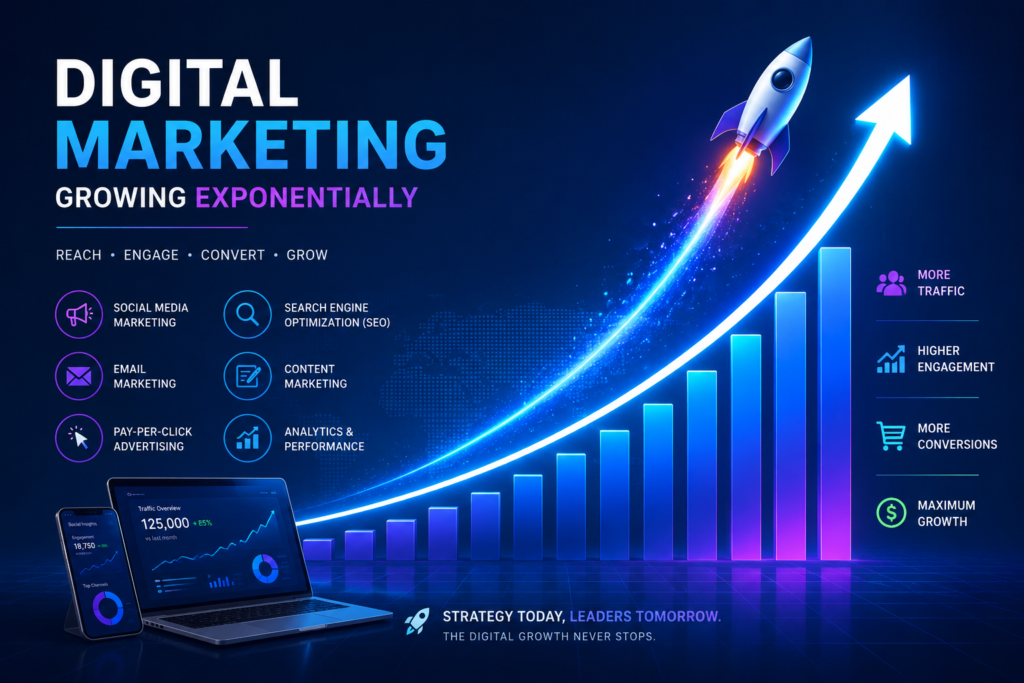
Digital marketing has long outpaced traditional advertising, but the trajectory heading into 2030 is unlike anything the industry has seen. Internet penetration, once a barrier in emerging economies, is rapidly dissolving. With over 5.5 billion people online today and projections crossing 6.5 billion by 2030, brands have access to a consumer base of unprecedented scale and connectivity.
The rise of affordable smartphones across South and Southeast Asia, Sub-Saharan Africa, and Latin America is unlocking entirely new markets. India alone is expected to add 200 million new internet users before the decade’s end — each one a potential customer discoverable through a targeted ad, a well-placed reel, or a personalised email at the right moment.
| $870B Global Digital Ad Spend by 2030 |
| 6.5B Internet Users Projected by 2030 |
| 72% Of All Ad Spend Will Be Digital |
| 45% YoY Growth in AI-Driven Campaigns |
Brands that once considered “go ing digital” optional are now treating it as existential. The pandemic years accelerated a decade’s worth of e-commerce and social media adoption into roughly 18 months. That behavioural shift did not reverse — it compounded. Consumers who discovered the convenience of online shopping, streaming, and digital banking in 2020 have not gone back, and they are spending more time — and more money — in digital environments each year.
AI Is Not the Future. It Is the Present.
How machine intelligence is becoming the backbone of every campaign Grow your report
No force is reshaping digital marketing faster than artificial intelligence. What began as algorithmic ad targeting has evolved into generative creative, predictive audience modelling, real-time personalisation engines, and conversational commerce — all powered by large language models and deep neural networks that learn at machine speed
By 2030, AI will not assist marketers — it will co-author every campaign, negotiate every media buy, and personalise every touchpoint at a scale no human team could replicate.
Programmatic advertising — already accounting for 72% of all digital display ads globally — will become near-entirely AI-orchestrated. Dynamic creative optimisation will mean that the banner ad you see is not the same one your colleague sees; both are generated in milliseconds, calibrated to your browsing history, emotional state indicators, time of day, and purchase intent signals.
Generative AI tools are democratising content production at an extraordinary rate. Small businesses in Jaipur or Jakarta can now produce video campaigns, social copy, and SEO-optimised blog content at a fraction of what it cost three years ago. This democratisation is not just levelling the playing field — it is expanding the entire arena.
Six Forces Defining Digital Marketing by 2030
-
- Hyper-Personalisation at ScaleAI-driven engines will serve uniquely tailored content to every individual user in real time. The era of “segment of one” marketing — long theorised — becomes operational reality by 2027.
-
- Voice & Conversational CommerceWith smart speakers in 1 in 3 households and AI assistants embedded in everything from fridges to cars, voice search and voice-triggered purchase will represent a $45B channel by 2030.
-
- Short-Form Video DominanceReels, Shorts, and their successors will capture over 80% of all mobile internet traffic. Brands that cannot tell a compelling story in 15 seconds will struggle for attention in a speed-scrolling world.
-
- The Creator Economy’s MaturationInfluencer marketing — projected to hit $48B by 2030 — will professionalise dramatically. Micro and nano influencers with niche, highly engaged audiences will outperform celebrity endorsements in conversion metrics.
-
- Privacy-First, Cookieless TargetingThe death of third-party cookies is forcing a fundamental rethink of audience targeting. First-party data strategies, contextual advertising, and data clean rooms are the new standard — and the brands building them now will have insurmountable advantages by 2030.
-
- Augmented & Immersive ExperiencesAR try-ons, virtual showrooms, and immersive brand worlds within gaming platforms (Roblox, Fortnite and their successors) are moving from novelty to necessity for consumer-facing brands targeting Gen Z and Gen Alpha.
Where the Next Billion Customers Are
South Asia, Africa, and Southeast Asia are the growth frontier
While the US and Europe remain the largest digital advertising markets in absolute terms, their growth rates are maturing. The explosive acceleration is happening elsewhere. India’s digital advertising market is expected to grow at a CAGR of over 20% through 2030, driven by a young, mobile-first population, deepening UPI adoption, and the rise of vernacular-language content consumption.
Africa’s digital economy tells an equally compelling story. With a median age of 19 and rapidly expanding 4G and 5G infrastructure, the continent is poised for its own digital marketing renaissance. Brands that establish presence and cultural relevance in Lagos, Nairobi, and Accra today are planting seeds for the consumer relationships of 2030.
For marketers, this geographic diversification demands a radical rethinking of strategy. Language, cultural context, platform preference (WhatsApp commerce is already dominant across multiple emerging markets), and payment infrastructure all vary enormously. The one-size-fits-all global campaign is a relic. Localisation — genuine, culturally intelligent localisation, not mere translation — will be a core competency.
What Marketers Must Do Now
The Strategic Imperatives for the Road AheadGrow your report
Six years to prepare. The time to act is now.
The boom is coming whether you are ready or not. The question is not whether digital marketing will dominate the commercial landscape by 2030 — it already does. The question is whether your brand, your team, and your strategy will be positioned to ride this wave or be swept under it.
Invest in first-party data infrastructure today. Build authentic creator relationships before the market inflates further. Experiment aggressively with AI-assisted content and targeting while the technology is still young and the competitive advantage of early adoption is still accessible. Develop cultural fluency in the emerging markets that will power global growth.
Above all, remember that at the centre of every algorithm, every data point, and every optimised campaign is a human being — with needs, emotions, and the capacity to build or break brand loyalty in a single experience. The technology will evolve relentlessly. The fundamentals of great marketing — relevance, resonance, and trust — will not.
The digital marketing boom by 2030 is not just a market opportunity. It is a mandate for transformation. The brands that answer it boldly will define the commercial decade to come.
The Future Is Digital.
Is Your Brand Ready?